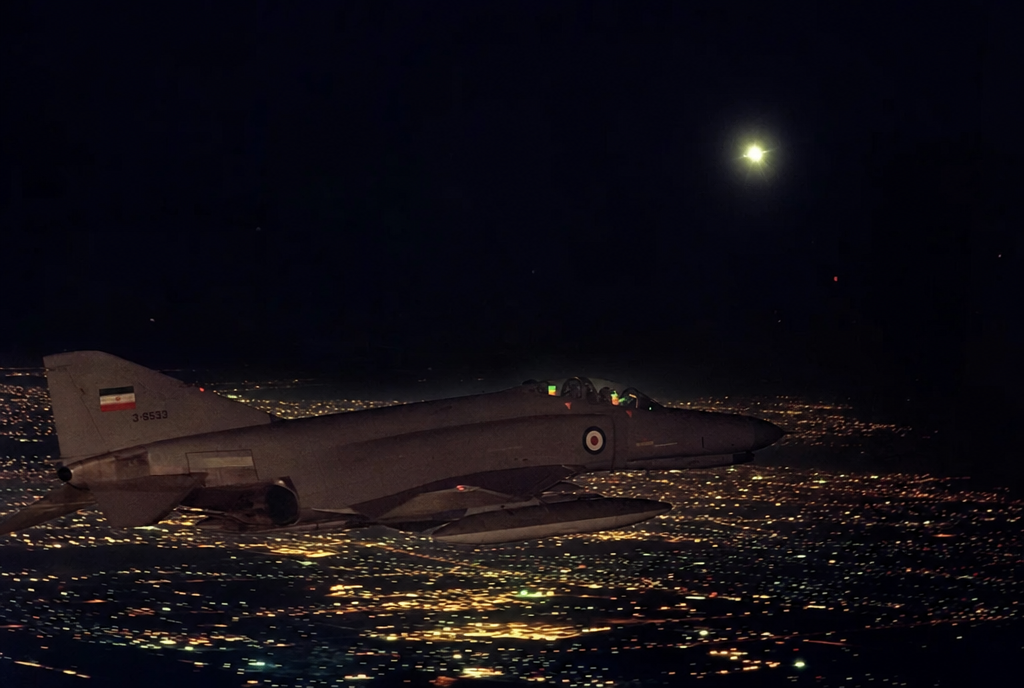
CURATED ARCHIVE, USER UPLOAD · Curated UNVEILED archive image
Verified HistoricalMilitary Encounter#tehran-1976#military#government#historic#craft-sighting
Tehran F-4 Incident
Date
1976-09-19
Location
Tehran
Witnesses
IIAF pilots, ground radar, civilians
Type
military
Entity
Unknown
Craft
Bright object + sub-craft
Evidence
multiple
Reality
physical
Evidence Index
92/100
Popularity
100/100
Community Rating
4.7 (196)
Encounter DNA
72 similar encounters discovered
Compare traits, communications, symptoms and locations.
Full Report
OPENING SCENE
It was just past 12:30 a.m. on Sunday, September 19, 1976, when the duty officer at Mehrabad Airport tower in Tehran began receiving phone calls from citizens reporting a brilliant white light hovering north of the Iranian capital. The Imperial Iranian Air Force scrambled an F-4D Phantom from Shahrokhi Air Force Base. As the F-4 closed the distance, the pilot — Captain Mohammad Reza Azizkhani — reported a complete failure of his instrumentation and weapons electronics, and broke off the intercept. A second F-4, flown by Lt. Parviz Jafari, was scrambled. As Jafari achieved a radar lock at 27 nautical miles, the object — described by Iranian Air Defense as roughly the size of a Boeing 707 with a strobe of red, green, blue and orange lights — performed a brief manoeuvre. Jafari attempted to fire an AIM-9 Sidewinder. His weapons panel went dead. So did his communications. The encounter would be reported by Iranian Air Defense to the U.S. Defense Intelligence Agency and, four months later, written up in a DIA cable that has since become one of the most-cited official UAP documents of the Cold War.
BACKGROUND
In 1976 Iran was a U.S. ally under the Shah, and the Imperial Iranian Air Force operated American-made F-4 Phantoms with U.S. military advisors present. The incident over Tehran was investigated jointly by the Iranian command and the U.S. DIA. The four-page DIA cable from January 1977 — declassified under the Freedom of Information Act in the early 1980s — remains the most authoritative single document.
TIMELINE (Tehran local time)
• Sept 18, 1976, ~2330 — Mehrabad Tower begins receiving public calls.
• Sept 19, 1976, ~0030 — Iranian Air Defense investigates. Initial visual at 70° azimuth.
• 0030 — IIAF Shahrokhi Air Base alerted.
• 0045 — First F-4D (pilot Azizkhani) scrambled. He acquires a visual at about 70 nautical miles.
• 0050 — Azizkhani's F-4 experiences total instrument and communications failure as it approaches 25 nm. He breaks off; instruments restore when he turns away.
• 0100 — Second F-4D (pilot Jafari, backseater Lt. Jalil Damirian) scrambled.
• 0110 — Jafari acquires a radar lock at 27 nm.
• 0115 — A smaller, bright object is reported to detach from the primary and approach the F-4. Jafari attempts to fire an AIM-9 Sidewinder; his weapons panel and UHF communications fail. He attempts an evasive turn; the object follows briefly, then returns to the primary.
• 0120 — A second smaller object detaches and descends toward the ground. Jafari observes it land softly in a desert area south of Tehran. A bright light is reported on the ground at the landing site.
• 0130 — Jafari's instruments restore. He returns to Shahrokhi.
• Sept 19, morning — A search-team helicopter flies the alleged landing area. The team reports a single residence whose occupants describe an unusual noise during the night, but no physical traces are found.
• Jan 12, 1977 — U.S. Defense Intelligence Agency cable (4 pages) summarising the incident. Distributed to NSA, CIA, White House and DIA HQ.
• 1980s — Cable declassified.
• 2007 — Jafari (by then retired General Parviz Jafari) gives a televised interview to the U.S. National Press Club, reaffirming his account.
KEY WITNESSES & PEOPLE
• Capt. (later Gen.) Parviz Jafari — primary witness; IIAF F-4D pilot, intercept #2. Public testimony 2007.
• Lt. Jalil Damirian — backseat WSO, intercept #2.
• Capt. Mohammad Reza Azizkhani — pilot, intercept #1.
• Lt. Gen. Yousefi (Mehrabad command).
• U.S. Lt. Col. Olin R. Mooy — drafter of the DIA cable.
LOCATION
Skies north of Tehran, Iran. Approx. 35.7°N, 51.4°E. Alleged secondary-object landing area south of Tehran.
DATES & TIME PERIOD
Active encounter: September 18–19, 1976, ~2330 to 0130 local time.
SOURCE HISTORY
Unusually for a UFO case, the primary source is a formal U.S. military intelligence document — the DIA cable of January 12, 1977 — supplemented by Jafari's public testimony over three decades. The Iranian Air Force command produced an internal report which has not been fully publicly released.
EVIDENCE SUMMARY
• Witness testimony: Two trained military pilots plus one WSO; ground observers.
• Radar tracks: Yes — multiple radar contacts on both Mehrabad Approach radar and the F-4 AN/APQ-120 fire-control radar.
• Avionics anomalies: Documented by the DIA cable — two separate F-4s experienced instrument and weapons failures when within ~25 nm of the object; in both cases the failures cleared when the aircraft turned away.
• Physical traces at alleged landing site: None recovered.
• Photographs / video: None.
• Government investigation: Yes — the DIA assessment is the primary surviving record.
MEDIA SUMMARY
No verified photographs or video. The most-cited image is the DIA cable itself, often reproduced verbatim in UAP literature.
OFFICIAL RECORDS
• U.S. Defense Intelligence Agency cable, "Reported UFO Sighting," January 12, 1977 (declassified). Cited file: DIA-RDS-2T-Iran-Sept-1976.
• Imperial Iranian Air Force internal report (not publicly released; cited indirectly by Jafari).
• Pentagon UAP Task Force / AARO 2024 Historical Record Report acknowledges the case among "well-documented historical incidents."
MAJOR CLAIMS
• A large luminous object hovered over Tehran for approximately two hours.
• Two F-4D Phantoms attempted intercepts. Both experienced complete instrument and weapons failure on close approach; both recovered when they broke off.
• A second smaller object detached and descended; one F-4 attempted a missile launch and the weapons panel went dead.
• Multi-radar tracking, including the F-4's own fire-control radar.
SKEPTICAL EXPLANATIONS
• Misidentified astronomical object (Jupiter): Skeptic Philip Klass argued in "UFOs: The Public Deceived" (1983) that the primary light could have been Jupiter, and that the avionics failures were unrelated coincidental malfunctions. The DIA cable explicitly considered and rejected this explanation, citing that Jupiter's altitude was inconsistent with the radar tracks.
• Meteor / bolide misidentification — possible for the initial light, less plausible for the two-hour duration.
• Avionics coincidence — the F-4D's AN/APQ-120 radar and AN/AWG-10 fire-control system are known to have intermittent failure modes; two simultaneous failures on two different aircraft, however, is statistically unusual.
DISPUTED DETAILS
• The accuracy of the visual size estimate ("Boeing 707-sized").
• Whether a secondary object actually landed.
• The full sequence of avionics failures — the DIA cable's level of detail is incomplete by modern standards.
• Whether the Iranian Air Force internal report contains additional information not in the U.S. DIA cable.
DIFFERENT PERSPECTIVES
• Disclosure view: A clean, multi-aircraft, multi-radar military encounter with documented avionics interference — comparable in evidentiary quality to USS Nimitz (2004), 28 years earlier.
• Skeptic view (Klass): A bright planet plus mundane equipment failures, written up under political and cultural pressure.
• Historian view: The case is one of the cleanest pre-1980 military UFO records and an important precedent for later disclosure-era discussions.
LATER DEVELOPMENTS
• 2007 — Jafari's public testimony at the U.S. National Press Club, organized by James Fox.
• 2010 — Iranian state media reaffirms the case as historically accurate.
• 2024 — AARO Historical Record Report references the case.
CULTURAL IMPACT
A canonical Cold-War-era military UFO case routinely cited in disclosure-era policy discussions; the Tehran incident, along with the Belgian Wave (1989–90) and the Nimitz Tic Tac (2004), forms the three-case "modern military UAP" backbone of public-policy testimony.
RELATED CASES
• Belgian UFO Wave (1989–1990) — multi-radar, F-16 lock-on.
• USS Nimitz Tic Tac Encounter (2004) — modern parallel.
• Mantell UFO Incident (1948) — early aviation case.
REFERENCES & SOURCES
• U.S. Defense Intelligence Agency, "Reported UFO Sighting," Jan 12, 1977 (full FOIA copy widely available).
• Jafari, Gen. Parviz — National Press Club public testimony, Nov 12, 2007.
• Klass, Philip J. "UFOs: The Public Deceived" (Prometheus, 1983).
• Fawcett, Lawrence & Greenwood, Barry. "Clear Intent: The Government Coverup of the UFO Experience" (Prentice-Hall, 1984).
Witness Discussion2
Sign in to discuss this dossier and vote on the archive.
Log in0

What I find compelling is the documentation. DIA cable, weapons-system failures across two airframes, ground witnesses, this isn't anecdotal.
0

The redundant systems failure on the second F-4 is technically very hard to explain. I've spoken to two F-4 pilots, neither could replicate it.
Similar Cases
video
Historical
CURATED ARCHIVE, USER UPLOAD
2004-11-14 · Pacific Ocean off San Diego, United States
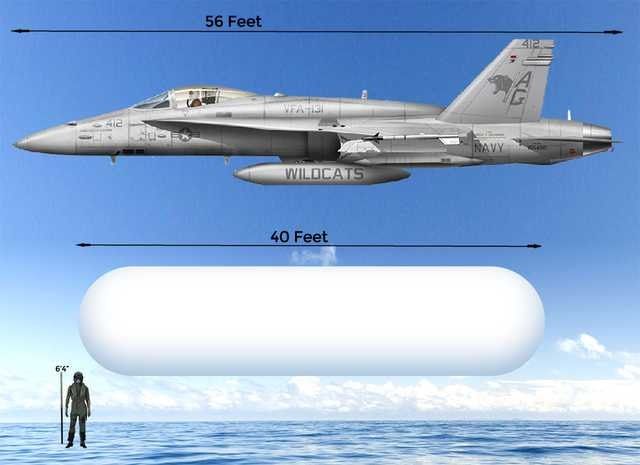
USS Nimitz 'Tic Tac' Encounter
Declassified US Navy encounter with a tic-tac shaped craft displaying impossible flight characteristics, confirmed by the Department of Defense.
Military Encountermilitary
documentation
Historical
ARCHIVE REFERENCE
2007-09-01 · Pentagon, Arlington, VA, United States
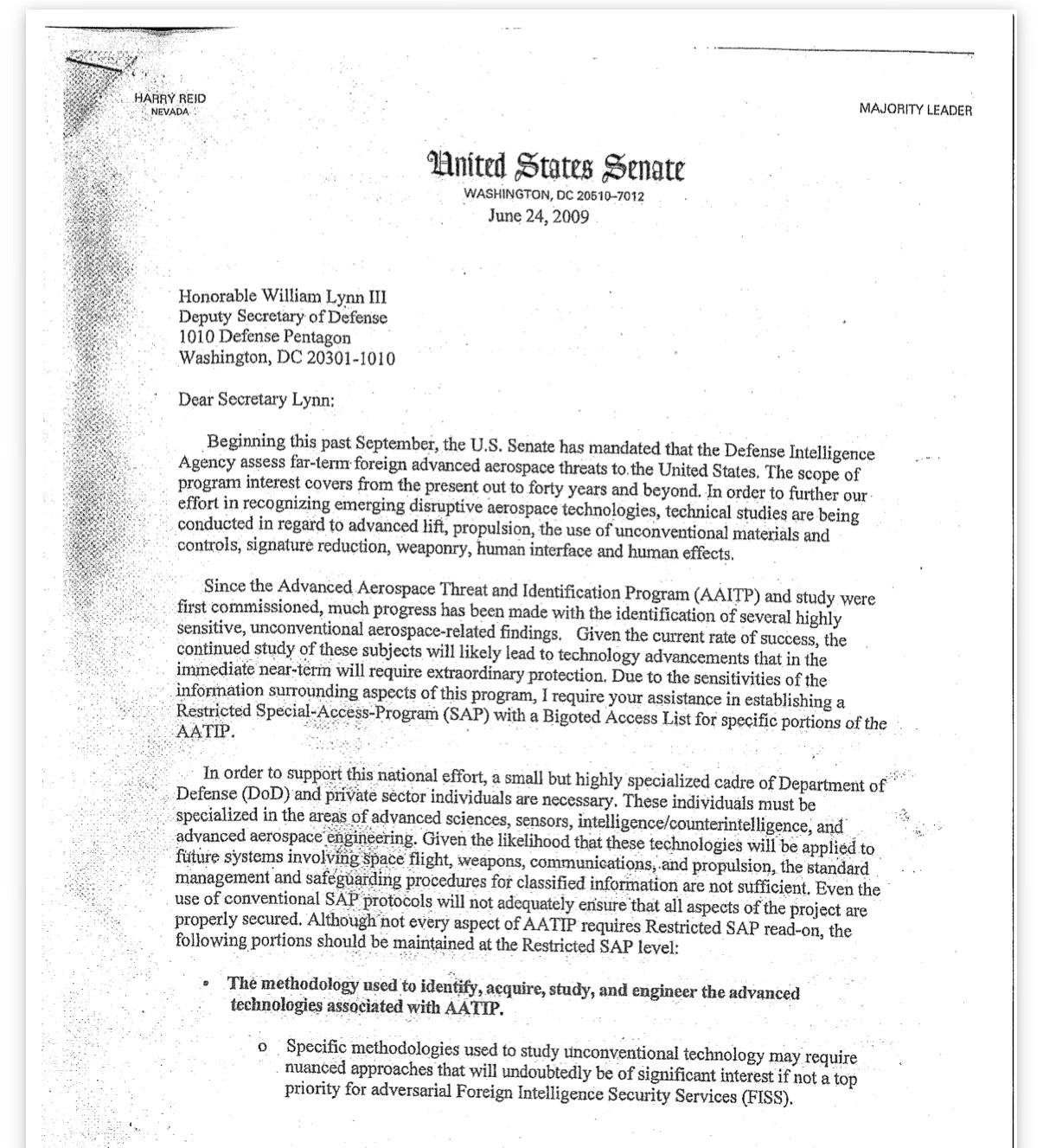
AATIP: Advanced Aerospace Threat Identification Program
Government Recordgovernment-related
video
Historical
ARCHIVE REFERENCE
2019-07-30 · Pacific Ocean off California, United States
USS Russell Pyramid UAP
Military Encountermilitary
video
Historical
CURATED ARCHIVE, USER UPLOAD
2015-01-21 · Atlantic Ocean off Florida, United States
Gimbal Encounter
Military Encountermilitary
multiple
Historical
CURATED ARCHIVE, USER UPLOAD
1989-11-29 · Eupen, Wallonia, Belgium
Belgian UFO Wave
Military Encountermass-sighting
multiple
Historical
ARCHIVE REFERENCE
2019-07-15 · Pacific Ocean off San Diego, United States
USS Omaha UAP Swarm
Military Encountermilitary