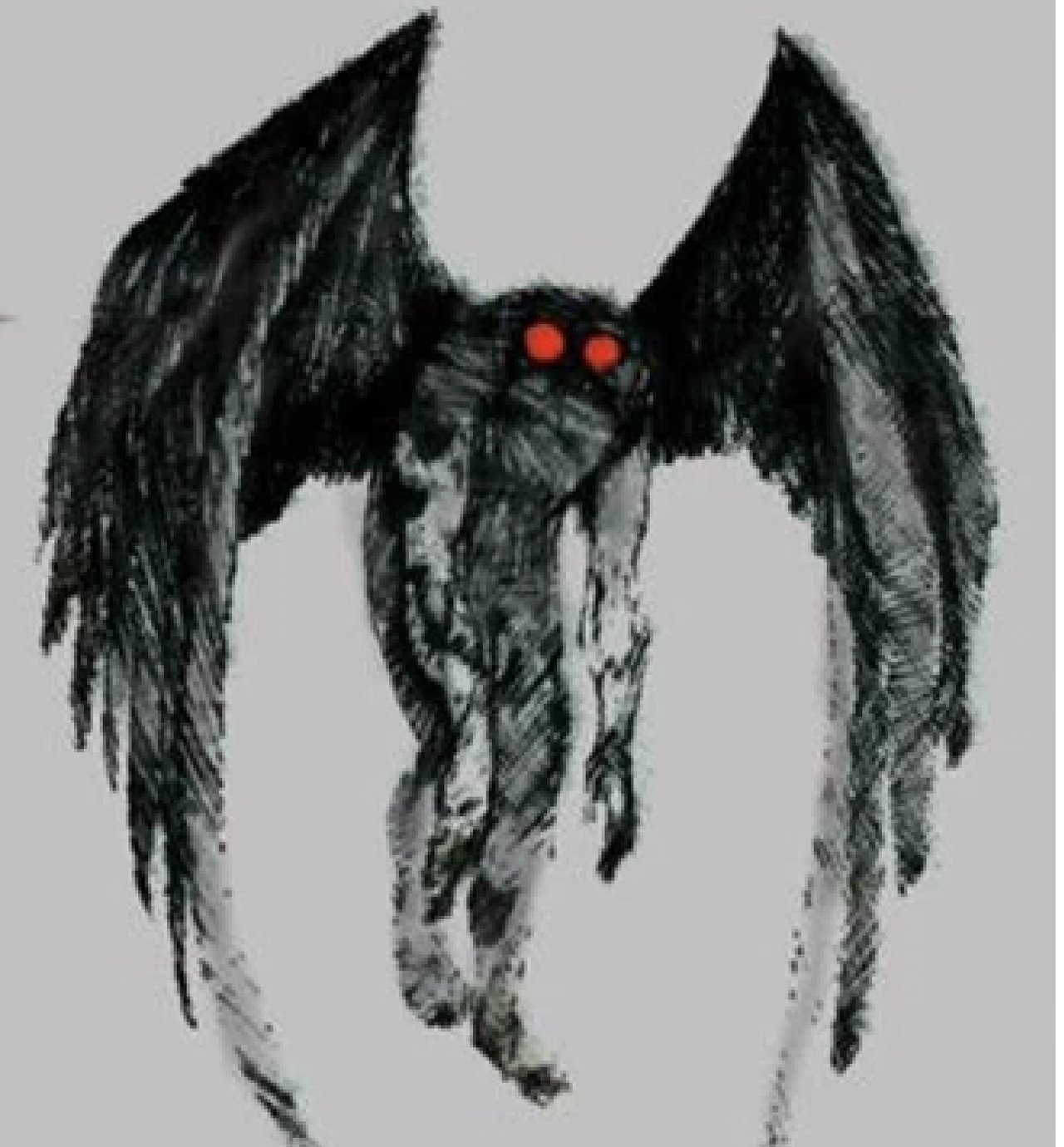
Visual rendition based on witness descriptions · Artist's rendition of the Mothman as described by Point Pleasant witnesses (1966–67). Not a photograph.
Verified HistoricalWitness Testimony#mothman#cryptid#winged-humanoid#red-eyes#point-pleasant
The Mothman of Point Pleasant
Date
1966-11-15
Location
Point Pleasant, West Virginia
Witnesses
Multiple Point Pleasant residents
Type
cryptid-encounter
Entity
Other
Craft
—
Evidence
testimony
Reality
physical
Evidence Index
70/100
Popularity
100/100
Community Rating
4.6 (522)
Encounter DNA
72 similar encounters discovered
Compare traits, communications, symptoms and locations.
Full Report
OPENING SCENE
It was just after 11:30 p.m. on Tuesday, November 15, 1966, on a winding road into an abandoned World War II munitions plant outside Point Pleasant, West Virginia — a place locals called the "TNT Area." Two young couples in a 1957 Chevrolet rounded a curve near a derelict power station when their headlights caught what they would later describe in police statements as a creature roughly seven feet tall, with grey, leathery skin, and two enormous, red, reflective eyes set high in the chest. As they accelerated away in panic, the figure unfolded what looked like wings and rose silently after them, pacing the car at speeds witnesses estimated at over 100 mph.
The next morning, the four — Roger and Linda Scarberry, Steve and Mary Mallette — sat in the Mason County Sheriff's Office and told Deputy Millard Halstead what they had seen. Halstead, who had known the Scarberrys for years, said he had never seen four people more genuinely frightened. He issued a public statement that same day, and the local Point Pleasant Register ran the now-famous headline: "Couples See Man-Sized Bird … Creature … Something."
The story did not end there. Over the next thirteen months more than a hundred Point Pleasant residents reported seeing the same figure — and then, on December 15, 1967, the Silver Bridge collapsed into the Ohio River during rush-hour traffic, killing 46 people. After the disaster the sightings ceased almost entirely. To this day the Mothman remains one of the most carefully documented, and most fiercely contested, cases in modern American folklore.
BACKGROUND
Point Pleasant in 1966 was a small Ohio-river industrial town of roughly 6,000 people, set in a sparsely populated stretch of West Virginia farmland. The "TNT Area" outside town was a 2,500-acre tract of forest and abandoned concrete bunkers left over from the West Virginia Ordnance Works, which had manufactured TNT during World War II. By the mid-1960s the bunkers were overgrown, the surrounding ponds were polluted with chemical runoff, and the place was a popular but unsettling parking spot for local teenagers. It is in and around these bunkers that almost every Mothman sighting was reported.
The case was popularised nationally by John A. Keel, a New York journalist who spent significant time in Point Pleasant between November 1966 and the bridge collapse. Keel's 1975 book "The Mothman Prophecies" interleaves the sightings with reports of Men in Black, telephone interference, lights in the sky, and premonitions surrounding the bridge collapse. Keel's book is the primary cultural vector for the case but is also the most disputed source: he openly mixed reportage, witness interviews, and his own paranormal framework, and modern historians treat individual claims in it case-by-case.
TIMELINE
• Nov 12, 1966 — Five gravediggers near Clendenin, WV report a brown human-shaped figure flying low overhead. (Often cited as the first sighting, but the witnesses were not from Point Pleasant proper.)
• Nov 14, 1966 — Newell Partridge, a Salem, WV contractor, reports his television "lined out" and his dog Bandit ran toward a pair of red, glowing "bicycle reflector" eyes near a hay barn. Bandit was never seen again.
• Nov 15, 1966 — Scarberry/Mallette sighting in the TNT Area. Police statement filed the same night.
• Nov 16, 1966 — Sheriff George Johnson holds a press conference; the story goes national via the Associated Press.
• Nov 16–25, 1966 — Dozens of additional sightings reported across Mason and Pleasants counties. Investigative reporter Mary Hyre of the Athens Messenger begins logging witness names and physical details.
• Nov–Dec 1966 through 1967 — Sightings continue, often near the TNT bunkers and over the Silver Bridge.
• Dec 15, 1967 — The Silver Bridge between Point Pleasant, WV and Gallipolis, OH collapses at 5:00 p.m. local time. 46 confirmed dead.
• After Dec 15, 1967 — Sightings drop sharply. A small number are reported in subsequent decades but never with the same density.
KEY WITNESSES & PEOPLE
• Roger and Linda Scarberry, Steve and Mary Mallette — primary witnesses, Nov 15, 1966. Signed police statements.
• Deputy Millard Halstead — Mason County Sheriff's Office. First law-enforcement officer to interview the witnesses.
• Mary Hyre — reporter for the Athens Messenger. Logged dozens of witness reports first-hand. Her files were the principal local archive of the case.
• John A. Keel — journalist, author of "The Mothman Prophecies" (1975). Single most influential popular source. Use with appropriate critical distance.
• Newell Partridge — Salem, WV. Reported the Nov 14 incident with his dog Bandit.
• Sheriff George Johnson — local law enforcement; ran the original press conference.
LOCATION
Point Pleasant, Mason County, West Virginia, USA. The center of the sighting cluster is the former West Virginia Ordnance Works ("TNT Area"), a 2,500-acre area of forested wetlands roughly 4 miles north of town. Coordinates: ~38.844°N, 82.137°W.
DATES & TIME PERIOD
Primary sighting wave: November 12, 1966 through December 15, 1967. Sporadic later reports occur into the 1980s but with much lower density and credibility.
SOURCE HISTORY
The case entered the public record through three channels in 1966–67: (1) signed police statements filed at the Mason County Sheriff's Office; (2) contemporary Associated Press wire stories; (3) Mary Hyre's columns in the Athens Messenger and the Point Pleasant Register. John Keel's later book (1975) added witness interviews conducted between 1967 and 1970 but also introduced material that scholars consider unreliable. The 2002 Mark Pellington film of the same name is dramatised fiction, not source material.
EVIDENCE SUMMARY
• Police reports: Yes, filed Nov 15, 1966. On record with Mason County.
• Photographs: None considered authentic. A widely circulated image is the Roger Patterson–style still from a later Mothman statue; many "Mothman photos" online are demonstrably from films and statues.
• Physical traces: None recovered.
• Multiple-witness independent corroboration: Yes — Mary Hyre's notes record more than 100 separate witnesses across the 13-month window.
• Government investigation: No formal investigation; the U.S. Air Force Project Blue Book did not file a Mothman entry.
MEDIA SUMMARY
The page hero is a Visual rendition based on witness descriptions — not a photograph, and not asserted to be evidence of the entity. No verified photographic record of Mothman exists.
OFFICIAL RECORDS
• Mason County Sheriff's Office police statement, Nov 15, 1966.
• Athens Messenger and Point Pleasant Register archives, 1966–67.
• U.S. Army Corps of Engineers report on the Silver Bridge collapse (Dec 1967): the collapse is officially attributed to a single faulty eyebar (eye-bar #330) in the suspension chain, not to any anomalous cause.
MAJOR CLAIMS (organised by source)
• Witness testimony: A roughly 7-foot tall, grey-skinned, winged humanoid with large red glowing eyes pursued vehicles near Point Pleasant.
• Witness testimony: The figure could fly without flapping and at speeds in excess of 100 mph.
• Keel (1975, disputed): Sightings clustered around the bunkers were paranormally connected to the Silver Bridge collapse.
• Folkloric / dramatised: Mothman is a "harbinger" of disaster. This is a literary device popularised by Keel and Pellington, not a witness claim.
SKEPTICAL EXPLANATIONS
• Misidentified sandhill crane — proposed by wildlife biologist Dr. Robert L. Smith of West Virginia University in 1966. Sandhill cranes reach almost 7 feet wingspan and have a red patch over the eyes; one had been reported off-migration in the area.
• Misidentified barred or great horned owl — large owls have eye-shine that reflects red in headlights and can be seen as humanoid when perched on fence-posts.
• Mass-hysteria contagion effect — once one credible-seeming sighting hit the AP wire, later reports were primed by it.
DISPUTED DETAILS
• Whether the Silver Bridge collapse is causally or coincidentally connected to the sightings. The bridge failure has a fully documented engineering cause; no surviving evidence connects it to the Mothman sightings.
• Whether "Men in Black" visited Point Pleasant residents during the wave. The MiB material comes almost exclusively from Keel and is contested.
• Whether the Mary Hyre incident log is complete or has been edited posthumously by republishers.
DIFFERENT PERSPECTIVES
• Cryptozoological: A previously undocumented winged biological entity, possibly relict from the TNT Area's contaminated wetlands.
• Folkloric / paranormal: Mothman is a Fortean phenomenon connected to a localised "window area" (Keel).
• Skeptical / zoological: Misidentified large bird augmented by media contagion.
• Cultural: Regardless of origin, the case is now part of Appalachian regional identity and West Virginia tourism.
LATER DEVELOPMENTS
• 2003 — A 12-foot stainless-steel Mothman statue by sculptor Bob Roach is installed in downtown Point Pleasant.
• 2005 — The Mothman Museum opens on Main Street.
• Annual Mothman Festival (since 2002) — third weekend of September; draws 10,000–15,000 visitors.
• 2016–2017 — A short revival of reported sightings around the Ohio Valley; none of these have signed police statements.
CULTURAL IMPACT
• "The Mothman Prophecies" (1975) — Keel's book remains the dominant popular source.
• "The Mothman Prophecies" (2002) — Mark Pellington's film starring Richard Gere, dramatised fiction loosely based on Keel.
• Mothman has become one of the three pillars of modern American cryptid lore (alongside Bigfoot and the Jersey Devil) and a sustained driver of regional tourism for Point Pleasant.
RELATED CASES
• Cornstalk Curse, Point Pleasant (1777) — local folklore predating Mothman.
• Flatwoods Monster (West Virginia, 1952) — another West Virginia cryptid encounter.
• Owlman of Mawnan (Cornwall, England, 1976) — strikingly similar witness descriptions a decade later, often compared in the literature.
REFERENCES & SOURCES
• Keel, John A. "The Mothman Prophecies" (Saturday Review Press, 1975).
• Sergent, Donnie & Wamsley, Jeff. "Mothman: The Facts Behind the Legend" (Mothman Press, 2002) — interviews with primary witnesses.
• Mason County Sheriff's Office records, Nov 15, 1966.
• U.S. Army Corps of Engineers, "Collapse of the U.S. 35 Highway Bridge, Point Pleasant, West Virginia, December 15, 1967" (final report, 1971).
• Smith, Dr. Robert L. — public statements as quoted in the Charleston Gazette, Nov–Dec 1966.
• Wikipedia entry "Mothman" (community-maintained summary) — https://en.wikipedia.org/wiki/Mothman
Attached Media
Visual rendition based on witness descriptions
Mothman — visual rendition based on witness descriptions
Artist's rendition of the winged humanoid figure described by Point Pleasant witnesses (1966–67). Not a photograph — no verified photographic evidence of the entity exists.
Source: Unveiled archive — visual rendition
Witness Discussion1
Sign in to discuss this dossier and vote on the archive.
Log in0

Worth noting that the sandhill crane explanation is older than people think, Dr. Robert L. Smith proposed it almost in real time in 1966. That doesn’t close the case but it’s a useful anchor.
Similar Cases
physical
Historical
ARCHIVE REFERENCE
1964-04-24 · Socorro, New Mexico, United States
Lonnie Zamora Socorro Landing
Witness Testimonyclose-encounter

testimony
Historical
CURATED ARCHIVE, USER UPLOAD
1973-10-11 · Pascagoula, Mississippi, United States
Pascagoula Abduction
Witness Testimonyabduction
multiple
Historical
ARCHIVE REFERENCE
1952-09-12 · Flatwoods, West Virginia, United States
Flatwoods Monster
Witness Testimonybeing-encounter

testimony
Historical
CURATED ARCHIVE, USER UPLOAD
1996-01-20 · Varginha, Minas Gerais, Brazil
Varginha UFO Incident
Military Encounterbeing-encounter
testimony
Historical
CURATED ARCHIVE, USER UPLOAD
1955-08-21 · Kelly, Kentucky, United States
Kelly-Hopkinsville Encounter
Historical Accountsiege

documentation
Historical
ARCHIVE REFERENCE
0593-07-01 · Banks of the Chebar River, Babylonia (modern Iraq)
Ezekiel's Wheel
Religious Textreligious-vision